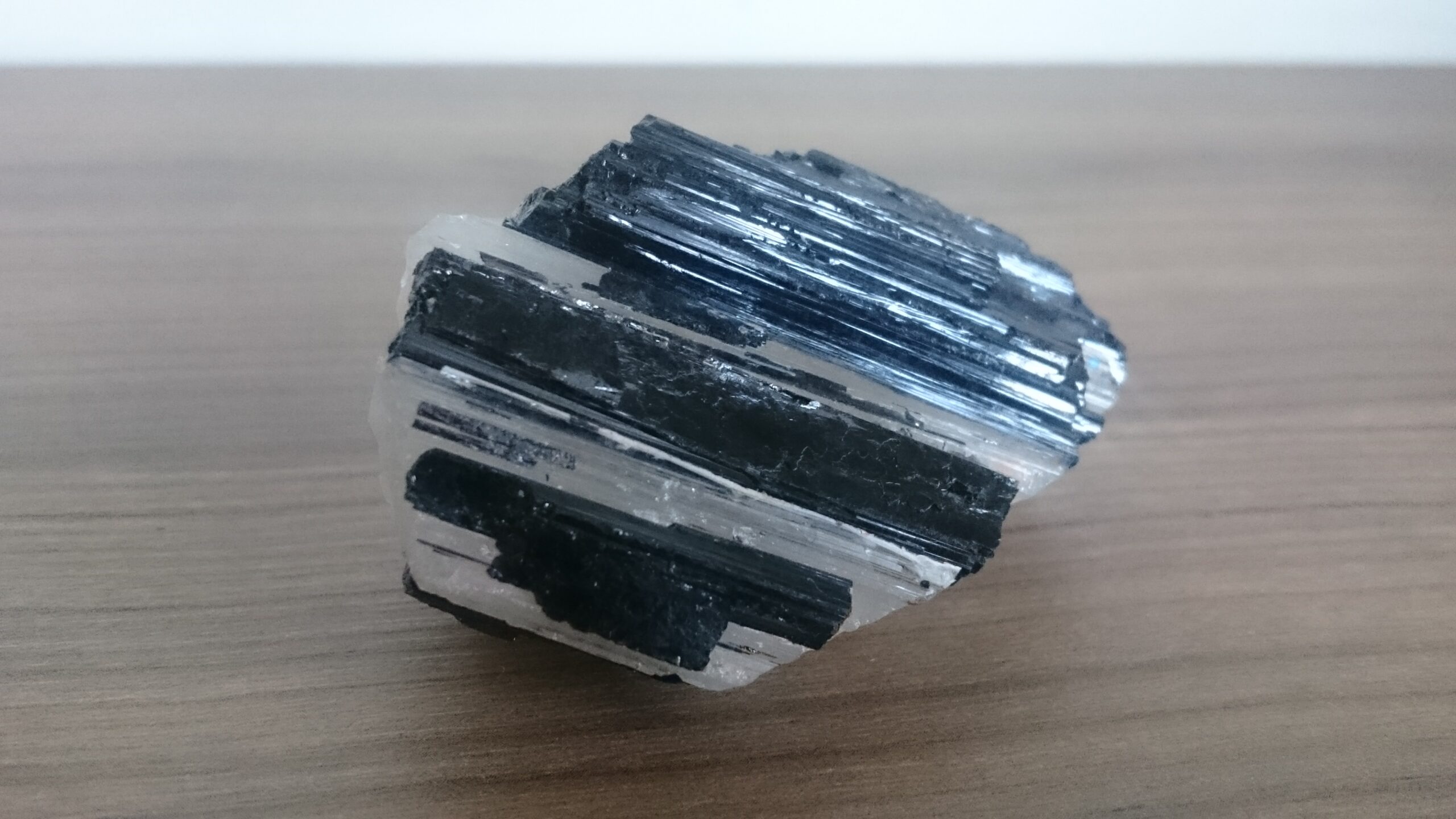
If your Black Tourmaline is dirty, start with physical cleaning. The Gemological Institute of America says warm, soapy water is the best cleaning method for tourmaline and does not recommend ultrasonic or steam cleaners.
If by “cleanse” you mean a personal ritual, that is a different job. Sound, smoke, moonlight, or intention appear in contemporary crystal practice, but they are not evidence that tourmaline stores or releases measurable “negative energy.”
Use this distinction first:
| Your goal | What you are actually doing | Best starting point |
|---|---|---|
| Remove dust, oils, or grime | CLEAN | GIA-backed tourmaline care |
| Care for a bracelet, pendant, or setting | WHOLE-OBJECT CARE | Check every material in the piece |
| Mark a reset or personal practice | RITUAL | Choose an optional, low-contact method |
Clean the object; choose the ritual. They do not need the same rule.
How to physically clean Black Tourmaline
For known tourmaline, let material-care guidance do the work. GIA’s tourmaline care guide lists tourmaline at about 7 to 7.5 on the Mohs scale, describes its toughness as Fair, and says warm, soapy water is the best cleaning method.
That is the important part. At home, keep the handling gentle: use the GIA-backed warm-soapy-water method, avoid aggressive scrubbing or unnecessary temperature changes, and dry the object carefully afterward.
GIA also says ultrasonic and steam cleaners are not recommended for tourmaline. It notes that high heat can damage tourmaline and that sudden temperature change can cause fracturing.
So Mohs 7–7.5 is not a permission slip for every cleaning method. Mohs hardness describes scratch resistance; it does not turn into a universal soak timer, heat rule, or jewelry-care instruction.
Can Black Tourmaline go in water?
For ordinary physical cleaning of known tourmaline, a blanket “Black Tourmaline must never touch water” rule conflicts with GIA’s care guidance: warm, soapy water is the recommended cleaning method for tourmaline.
But “water can be used for cleaning tourmaline” is not the same claim as “every Black Tourmaline object should be soaked.”
The object in your hand may include more than the stone.
A finished bracelet, pendant, or set piece can add cord, elastic, metal, adhesive, coating, plating, or another gemstone. Those materials may have their own care limits. A loose tourmaline specimen and a strung bracelet can therefore require different decisions even when the stone name is the same.
A practical rule is:
- Loose, known tourmaline: start from GIA’s warm-soapy-water guidance.
- Finished jewelry: care for the whole object, not just the tourmaline.
- Unknown treatment, coating, glue, cord, or mixed material: use the more conservative whole-object method until you know what is present.
That is more accurate than turning “water” into a universal yes/no category.
Why “cleaning” and “cleansing” get mixed together
Current Black Tourmaline guides often use the word cleanse for two unrelated tasks. One page may mean removing dirt. Another may mean a spiritual or symbolic reset. That is why search results can recommend running water, warn against all water, prescribe smoke or salt, and then attach a fixed weekly schedule—all for the same query.
Separate the jobs and the contradiction becomes manageable.
Physical cleaning asks: What safely removes dirt from tourmaline or from the finished object?
Ritual cleansing asks: What action helps me mark a reset, transition, or intention?
The second question can matter personally without being turned into a claim about measurable mineral efficacy. There is no material-care basis for saying Black Tourmaline must be ritually cleansed every seven days, or that a subjective feeling proves the stone has accumulated a physical substance called “negative energy.”
Three optional dry ritual choices
If the object is already physically clean and you want a ritual, a dry, low-contact option keeps the symbolism separate from material care.
Sound
Set the stone or jewelry on a stable dry surface and use a bell, chime, singing bowl, or another sound that has meaning for you.
The ritual can be the pause itself. You do not need to claim that sound physically changes tourmaline.
Intention
Hold the piece, set it down, or take a quiet moment to decide what you want the object to represent before you use or wear it again.
There is no required duration and no invisible “full” or “empty” state you need to diagnose.
Moonlight
Moonlight is another common symbolic choice. If you enjoy that practice, keep the piece dry and in a stable location and treat the act as personal ritual rather than mineral maintenance.
You can also skip ritual cleansing entirely. Physical care is about the object; ritual is optional.
What about salt, smoke, or burying the stone?
You will also see salt, smoke, soil, and other methods in contemporary crystal guides. They are not required to clean tourmaline, and they introduce extra contact or materials that are unnecessary if your only goal is a symbolic reset.
If you prefer ritual, the simplest approach is often the one that leaves the object physically alone: sound, intention, or another dry practice you already value.
If the stone is actually dirty, switch back to material care instead of asking a ritual method to do a cleaning job.
The whole-object check is the part most guides skip
Before cleaning Black Tourmaline jewelry, look past the stone name.
Ask:
- Is the tourmaline loose or mounted?
- Is there elastic, cord, glue, coating, plating, or another gemstone?
- Does the maker provide care instructions for the finished piece?
- Am I removing physical dirt, or performing a ritual?
That last question keeps two different decisions from collapsing into one.
You do not need to submerge finished jewelry because a ritual page recommends water. You also do not need to reject GIA-backed tourmaline cleaning because another page treats all water as dangerous. The right answer depends on what the object is and what job you are trying to do.
How often should you clean or cleanse Black Tourmaline?
For physical cleaning, clean the object when it actually needs cleaning and according to the materials involved.
For a ritual, there is no evidence-based Black Tourmaline schedule. Daily, monthly, after a meaningful event, rarely, or never can all be personal choices. A precise-sounding rule such as “every 7–10 days” is still a ritual convention, not a gemological maintenance interval.
The two-question rule
When advice conflicts, ask only two things:
1. Is the problem physical dirt?
Use material care. For known tourmaline, GIA recommends warm, soapy water and advises against ultrasonic and steam cleaning. For jewelry, widen the decision to the whole object.
2. Is the goal symbolic or personal?
Choose an optional low-contact ritual if you want one. Do not turn the ritual into a claim about measurable energy, healing, or mineral maintenance.
That is the durable rule: clean the object; choose the ritual.
For mineral identity, history, Black Tourmaline meaning, and the boundary between physical properties and modern protection symbolism, see our Black Tourmaline guide.
Sources
- Gemological Institute of America — Tourmaline Care and Cleaning
- Gemological Institute of America — Tourmaline
Featured image: Black tourmaline with quartz, Timon Jahnert / mineralstudy.com, CC BY 2.0, via Wikimedia Commons. It is a real specimen image; it is not evidence for ritual, healing, protection, or energy effects.