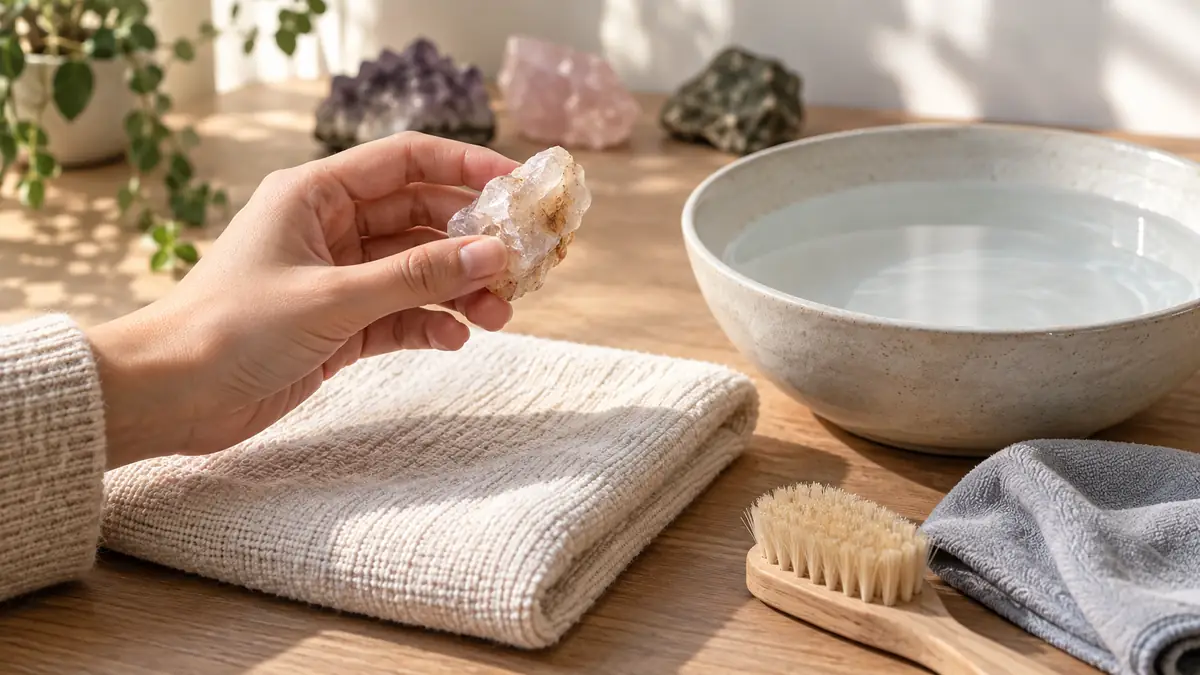
If you need a dependable no-soak starting point, remember two names: selenite/gypsum and halite. Water can dissolve these materials, so immersion is a poor preservation choice.
That is deliberately narrower than saying one accidental splash destroys a crystal. “Cannot go in water” is how people search; “do not soak this material” is the more useful care rule.
The trouble starts when that sensible caution becomes a giant blacklist. Search results often sort crystals by Mohs number, spelling, or a precise-looking timer. Those shortcuts mix together different questions—scratch resistance, solubility, treatments, jewelry construction, and whether you are simply cleaning an object or leaving it underwater.
The habit worth remembering is simpler:
Identify the material before you immerse the object.
The clearest no-soak cases are about solubility
The Smithsonian identifies selenite as a variety of gypsum. The U.S. Geological Survey describes gypsum and salt among the most soluble common rocks and discusses water dissolving evaporite materials. USGS research also documents halite solubility in water systems.
That gives selenite/gypsum and halite a real material reason to stay out of a soak. You do not need a dramatic “before and after” demonstration, and you do not need to guess a safe number of seconds. The preservation conclusion is enough: if a material is genuinely soluble, immersion is the wrong experiment.
If you are unsure how a particular specimen should be cleaned, keep it out of the bowl until you have care guidance for that material.
Mohs hardness cannot answer the water question by itself
Mohs hardness describes resistance to scratching. It does not measure solubility or certify a treatment, a setting, a string, or an entire finished object for immersion.
GIA care guidance makes that distinction visible without a theory lesson.
Rose quartz and citrine are quartz varieties at Mohs 7, and GIA lists warm soapy water as a safe cleaning method for them. GIA also recommends warm soapy water for turquoise, around Mohs 5–6, and opal, around Mohs 5–6.5. At the same time, the individual care pages carry different cautions involving treatments, heat, steam, or ultrasonic cleaning.
So a softer number does not automatically mean “never use water,” and a harder number does not automatically mean “safe to soak.”
Hardness can help answer how easily something scratches. It cannot replace material-specific care guidance.
A piece of jewelry is more than its center stone
A loose mineral on a tray and a finished necklace beside the sink may share a gemstone name while posing different care questions.
A setting, treatment, string, or second material can add a constraint that does not appear on the mineral’s Mohs line. That is why “this gem can be cleaned with warm soapy water” should not be silently expanded into “every object containing this gem can be soaked.”
GIA’s pearl guidance offers a clean example. Pearls may receive occasional warm soapy cleaning, but on a strung piece the string should be completely dry before the strand is worn again.
That is not a universal pearl rule pasted onto crystals. It shows why the whole object matters. Sometimes the relevant care question is not only “what is this stone?” but “what else am I holding with it?”
Three questions before anything goes in the bowl
When an unlabeled crystal is in your hand, ask three things.
1. What mineral is it?
If you cannot identify it, do not use a soak as a test. Verified soluble materials such as gypsum/selenite and halite already give you a clear reason to avoid immersion.
2. What is the whole object?
Is it a loose specimen, a treated or coated piece, or part of finished jewelry? Construction can add care constraints that the mineral name alone does not reveal.
3. Are you cleaning it, or soaking it?
A source that permits warm soapy water for cleaning is describing a cleaning method. That does not automatically authorize prolonged immersion, and it certainly does not create a universal soak timer.
If the identity, treatment, or assembly is unknown, use the conservative fallback: no soak until verified.
That is usually enough. Keep the uncertain piece dry, identify what you have, then follow care guidance for that material and object rather than testing it in water.
For species-specific examples, see Can Amethyst Go in Water? and Can Rose Quartz Go in Water?. The Citrine guide also gives useful quartz-family context without pretending a Mohs number is a complete care instruction.
Which crystals should you keep out of a soak?
Start with selenite/gypsum and halite. Their no-soak rule comes from material solubility, not a viral naming trick.
For everything else, skip the universal cutoff and identify what you actually have—stone, treatment, setting and purpose included.
Identify first. Clean second. Do not turn the bowl into a test.
Sources
- Smithsonian National Museum of Natural History — Selenite (gypsum) collection record
- U.S. Geological Survey — Evaporite karst in the United States
- U.S. Geological Survey — Halite solubility relations in water systems
- GIA — Rose Quartz Care and Cleaning
- GIA — Citrine Care and Cleaning
- GIA — Turquoise Care and Cleaning
- GIA — Opal Care and Cleaning
- GIA — Pearl Care and Cleaning
Featured image: an article-specific editorial illustration generated for Serenlith. It shows the decision to pause before immersion; it is not evidence of mineral identity, dissolution, damage, or treatment.