“Protection” can mean very different things.
If you mean physical safety, a crystal is not the answer: use the lock, leave the situation, contact the right person, seek medical care, document the problem, or change the technical setup. If you mean a symbolic boundary, grounding pause, reflection cue, or calm ritual, a stone can be a tangible reminder of the action you chose.
That is the useful line for this guide:
A protection stone can mark a boundary. It should not be asked to replace one.
Start with the job, not the “strongest” crystal
Current crystal guides and community discussions repeatedly associate black tourmaline, obsidian, smoky quartz, and amethyst with protection, grounding, boundaries, or calm. That is evidence of modern spiritual usage, not evidence that the minerals create a measurable protective field.
Choose one of four reader jobs:
- Boundary: I want a visible reminder of what I will and will not allow.
- Grounding: I want a cue to slow down and take the next practical step.
- Reflection: I want an object that marks time for journaling or self-examination.
- Calm ritual: I want a quiet object that helps me begin or end a personal practice.
Once the job is clear, the stone becomes easier to choose—and the claims become easier to keep honest.
Black tourmaline: a boundary cue
Black tourmaline recurs across current protection-crystal lists. Tourmaline is also a real mineral group with defined gemological properties; GIA lists tourmaline at about 7 to 7.5 on the Mohs scale.
Keep those two ideas separate. Hardness and other mineral properties describe the material. They do not establish EMF shielding, health protection, or an invisible barrier.
If black tourmaline is meaningful to you, give it a concrete job: place it beside your keys, notebook, or doorway as a reminder of a boundary you have already chosen.
For geology, meaning, care, and the existing protection-symbolism boundary, use our Black Tourmaline guide.
Obsidian: a reflection cue
Obsidian often appears beside crystals in protection lists, but materially it is volcanic glass, formed from rapidly cooled lava. Smithsonian records make that identity clear.
That distinction is useful. A spiritual category does not have to match a mineralogical category for the object to carry personal meaning.
Place obsidian beside a blank page and ask one question: What am I trying to protect my time, attention, or boundaries from today?
The stone does not have to remove a threat for the question to be useful.
Smoky quartz: a grounding pause
Smoky quartz is a variety of quartz. In current crystal practice, it is frequently described with grounding and protection language.
Here, treat “grounding” as a ritual cue rather than a medical or energetic mechanism. Keep the stone in a pocket or near a work area. When you notice it, stop for one breath and name the next concrete action.
The observable part is the pause and the action—not an invisible field.
Amethyst: a quiet reset
Amethyst is another quartz gem that appears in current protection lists, especially in calm or quiet-ritual contexts.
An amethyst on a desk can mark the moment you stop scrolling, close a task, or begin an evening ritual. Keep that in the symbolic lane; do not turn it into treatment for anxiety, insomnia, trauma, or another health condition.
For mineral identity and care, use our Amethyst guide.
What history can—and cannot—tell us
People have used stone and crystal amulets in specific historical cultures. The Metropolitan Museum of Art catalogs a New Kingdom Egyptian red jasper tit amulet whose context was protective in the afterlife. The Met also catalogs a Ptolemaic or Roman-period Harpokrates amulet made of crystal.
Those objects support a narrow, useful point: specific people in specific historical settings used specific stone or crystal amulets as protective symbols.
They do not prove that today’s black-tourmaline/obsidian/smoky-quartz list is one continuous ancient system, and they do not demonstrate a modern protective mechanism.
A four-question protection-crystal chooser
1. What job do I want the symbol to mark?
Boundary, grounding, reflection, or calm ritual. Pick one.
If your answer is physical danger, abuse, stalking, illness, a mental-health crisis, or a technical exposure concern, stop here and take the real-world safety or professional step instead.
2. Which object makes that job easy to remember?
A dark stone beside the door can mark a boundary. A stone beside a notebook can mark reflection. A small object in a pocket can mark a pause. A stone on a quiet desk can mark the beginning or end of a ritual.
The best choice is not the one with the most dramatic claim. It is the one that makes your chosen practice easy to repeat.
3. Can I keep material facts separate from spiritual meaning?
Check identity and care from mineral or gemological sources. Keep symbolic meanings in the category of tradition, current practice, or personal interpretation.
Do not turn a real property such as hardness, color, electrical behavior, or crystal structure into proof of an unrelated healing or shielding claim.
4. What action will happen when I notice the stone?
Make the action observable:
- “I will pause before replying.”
- “I will write down what happened.”
- “I will leave work at work when I put my keys down.”
- “I will close the task and begin my evening routine.”
The object is the cue. The action is yours.
A one-stone ritual is enough
You do not need a collection or a “strongest protection crystal” ranking.
Choose one job, one stone, one place, and one action. Doorway. Pocket. Notebook. Quiet desk. When you see or touch the object, perform the action you chose.
No aura visualization, charging schedule, salt bath, or fixed cleansing timetable is required for the ritual to have symbolic value.
Keep the exclusions short and clear
This guide does not claim that crystals block Wi-Fi, EMF, radiation, curses, psychic attacks, illness, anxiety, or physical harm. It does not present a crystal as a substitute for locks, healthcare, mental-health support, legal help, technical expertise, or interpersonal boundaries.
You can respect spiritual symbolism without presenting it as measured material performance.
The short answer
For crystals for protection, choose by job, not by ranking. Decide whether you want a boundary cue, grounding pause, reflection object, or calm ritual, then give one stone one observable action.
A protection stone can mark a boundary. It should not be asked to replace one.
Sources
- The Metropolitan Museum of Art — Tit Amulet
- The Metropolitan Museum of Art — Amulet of Harpokrates
- GIA — Tourmaline
- GIA — Tourmaline Care and Cleaning
- Smithsonian — Obsidian educational record
- GIA — Amethyst Care and Cleaning
- Serenlith — Black Tourmaline
- Serenlith — Amethyst
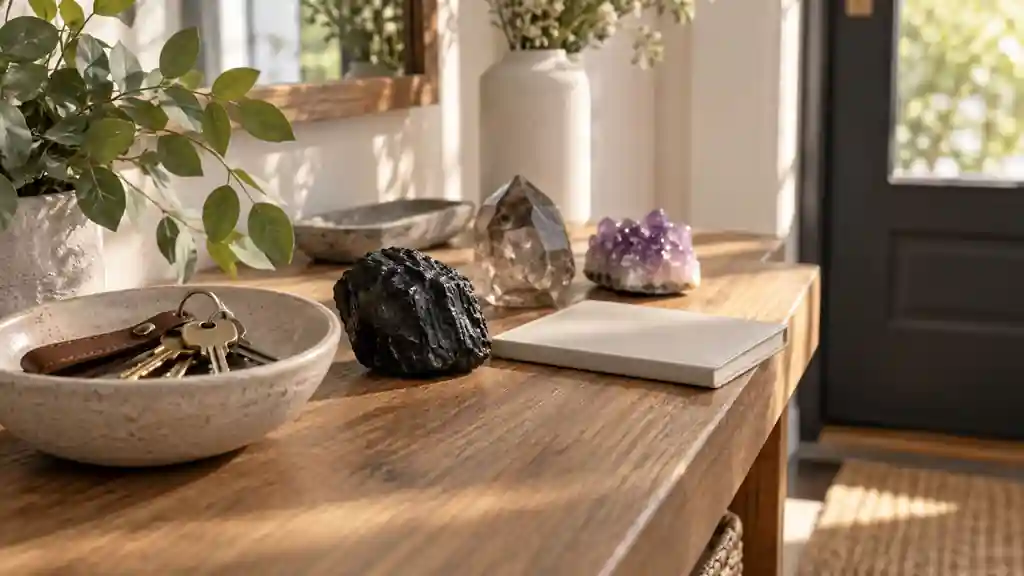
Featured image: an article-specific GPT Image 2 editorial illustration for Serenlith. It depicts a home-threshold boundary ritual and is not evidence of mineral identity, physical protection, healing, psychic effects, or EMF shielding.